As a child and new to Formula One, rather than being drawn to my fellow countrymen or simply who drove the fastest car, I gravitated towards a Polish Renault driver. My earliest memories of F1 began in 2007, but the 2010 season and Kubica’s campaign were the first to grab my full attention. As I watched each race that season, my passion for the sport grew. It took only two races to see Robert Kubica’s talent on full display. After qualifying 9th in Australia, Kubica drove his way to 2nd in tricky conditions while those around him fell apart. He quickly became my favourite driver as he battled the most notable names of the sport and came away with multiple finishes at the top end of the order, before he mesmerised in Monaco qualifying 2nd and leaving the weekend with a podium.

Kubica would finish the season 8th above Michael Schumacher, splitting the Mercedes drivers. Aside from the season opener, he scored points in every race he finished and featured on multiple podiums. Robert scored over eighty percent of Renaults points that season, hammering his teammate Vitaly Petrov in the head-to-head. Out-qualifying him seventeen times, only missing out on Q3 once before dragging the car to 5th on the Sunday. He only finished behind Petrov twice in a nineteen-race season. His dominant display left James Allison, Renault technical director at the time and a figure involved in thirteen championship winning cars stating “If we can give him [Kubica] a car that’s even half capable of getting a championship, he’ll get one.”

Kubica wasn’t a talent that came out of nowhere. In his karting years he won multiple championships, coming up against and beating future Formula One world champions in Lewis Hamilton and Nico Rosberg. In 2005 Robert would win the Renault 3.5 championship with ease and find himself rewarded with a test drive for Renault’s F1 team before becoming BMW Sauber’s reserve driver the following year. Half way into the season he would replace Jacques Villeneuve and out-qualify his experienced teammate Nick Heidfeld on his first attempt, beating him in three out of the six remaining races and score his first podium in the process.

His first full season didn’t go exactly to plan. The Canadian GP would see him lose control of his car after he was sent wide onto the grass, his car leapt off the ground as he went over a bump and careered into the wall at over one hundred and eighty miles per hour before rolling over to the other side of the track. The car was so badly damaged that his feet were left exposed. Unbelievably, Kubica would only miss a single race before returning to the cockpit. Confidence surely dented; Robert would lose fairly comfortably to his teammate that season, despite recording regular point finishes.

The following year Kubica’s talent was on display for all to see. He would hit the ground running, securing BMW Sauber’s first pole position and take a step on the podium twice in the first three races. On the back of finishing 2nd in Monaco he would take his maiden Formula One win on the track that saw his catastrophic accident just the year prior. This win would see him leading the world championship approaching the halfway stage of the season. However, concerned about the major rule changes due for 2009, BMW would focus their efforts on preparing for the future, shifting their resources from the race winning car of the current season. The Ferrari and McLaren were already quicker and would continue to out develop them for the remainder of the season, along with the teams around them. In spite of this, Robert would still score multiple podiums but his hopes of winning the title would never be realised. Robert would end the season a very respectable 4th, level on points with last year’s world champion, Kimi Räikkönen.

Sauber’s decision to stop development on the current car would continue to age poorly as they would find themselves fighting outside the points scoring positions for the majority of the season. The cars drop in performance would inevitably see a drop in Kubica’s stock, even with his 2nd place finish in Brazil. Come the end of the season he would announce his departure to Renault, replacing Fernando Alonso and taking a risk on the team that only finished 8th in the constructors standings. As I previously expressed, Robert was electric the following year, whilst driving what was arguably the 5th fastest car on track, he fought for multiple podiums and excelled on driver dependant tracks. His performances would see him peak Ferrari’s interest, already good friends with Alonso and with Massa struggling in the second car, Kubica revealed that he had signed a contract with the Italian team, expecting to join in the 2012 season.

Whilst preparing for his 2011 campaign Kubica would top the timing sheets in the opening testing session. In between pre-season testing he went to compete in the rally Ronde di Andora where, regrettably, he would crash and incur life changing injuries. A guard rail would pierce its way through the car, shattering the entire right side of his body, his arm would nearly be severed off and he would lose a dangerous amount of blood before being placed into an induced coma. Thankfully, the doctors were able to save both him and his arm. Robert would wake to a partial amputation and forty-two fractures. These are injuries that subject him to lifelong pain and limitations in his right arm, unable to fully twist his wrist. Stefano Domenicali, Ferrari team boss, expressed that he would “never race in the sport again” a sentiment shared by many. Robert suffered for the next few years as he recovered from his injuries, at the time I was devastated when his story broke, I had gone from eagerly anticipating what he might produce in the upcoming season to fearing he may never race in motorsport again. As news of his recovery was scarce and his return to F1 seemingly impossible, I was forced to follow new drivers such as Kobayashi and Perez along with the likes of Hamilton and Button but my interest in Kubica’s rehabilitation and career persisted. Even as I grew older my support for the driver that captivated my interest in the sport I fell in love with never waned. Fernando Alonso would describe him as “one of the best drivers of his generation.” Hamilton backed this up declaring “Robert is one of the most talented drivers I’ve competed against.” Despite the respect he had garnered from legends of the sport and fans alike, his name began to fall into obscurity, only appearing in memes circulating forums and occasionally featuring “F1’s biggest what ifs” lists.

Remarkably, Kubica would fight his way back to a condition capable of competing in a motorsport again. He would be rallying just a few years after the accident and win the WRC2 championship. Following this, he would enter the WRC, and even lead stages before leaving to race touring cars. His successful return to racing would earn him the opportunity to take part in a private test session with Renault’s F1 team in their 2012 car. There, he surprised everyone, putting in over one hundred laps, whilst consistently delivering impressive lap times. His performance would see him invited back for a second test. One that he impressed so much in, that his hat was thrown into the ring for a seat in the team for the 2018 season. Ultimately, Renault would stick with their already strong line up of Nico Hulkenberg and Carlos Sainz, but the fact he was considered with these two already in the team backs up how impressive he must have been to be considered. Hearing the rumours, Williams would take the opportunity to snap him up as their reserve driver.

F1’s “silly season” was in full effect in 2019 with multiple drivers moving teams or leaving the sport. with that, the opportunity arose for a comeback to the sport nearly a decade later. Kubica lined up along side rookie George Russell in the Williams. After being so cruelly taken out of the sport, fans were delighted for him to be back on the grid. Yet, he had his critics. Robert himself spoke recently about some of the backlash he received from ex-drivers and pundits noting “There was some very extreme quotes that hurt me.”
I myself found that his comeback wasn’t fully appreciated amongst the crowd. The rise of drive to survive was fantastic, it meant that many of my friends were now interested in the sport and we could discuss it at length. Nonetheless, they did not know who Kubica was and fairly so, but he was underappreciated by them and even mocked, just seen as some old boy who was going drive around in last place every week. To an extent that was true, Russell outqualified him in every session and bested him most weekends. However, on a rainy day in Hockenheim Kubica showed us a glimpse of what could have been. After lining up 18th he would finish 10th, scoring Williams only point of the season. It was a race that saw changing conditions, sending five drivers crashing out of the race and several more making errors. Not him though. Robert drove an extremely measured, faultless race, giving something for his fans to cheer for in a difficult season.

Come the end of the season he would step down from the Williams seat and return to his old Sauber team as reserve driver whilst also taking up endurance racing as he joined Team WRT in the LMP2 classification. He would find early success winning multiple races and the championship alongside his current teammate Yifiei Ye. The following year his quest for victory at the 24 Hours of Le Mans began. A race part of the triple crown and one of the most prestigious races in all of motorsport. Twenty-four hours in length, this race is one of the most demanding out there. His first two attempts would see him fall short to 2nd on both occasions. After taking victory in the final two races of the season and wrapping up another championship, Robert would take a step up into the hyper car classification, joining AF Corse. In 2024, Kubica would embark on his 3rd attempt at victory but it resulted in agony. He would display incredible defensive manoeuvres to hold off those behind as he led the race but contact with a BMW whilst lapping a LMP2 car would result in a 30 second stop go penalty, sending him down the order. His chance to reel the leaders back in would end abruptly with a motor generator forcing the team to retire.

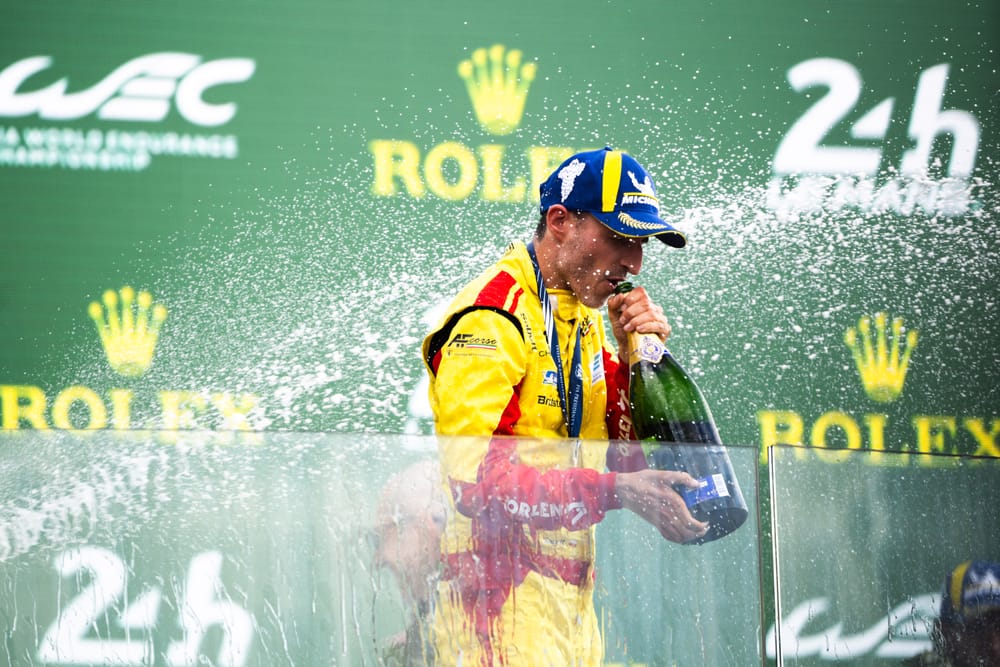
This year Kubica lined up 13th on the grid as he prepared to chase that illusive top step of the podium. Robert would go on to dig deeper than ever before and make history. He would become the first ever Polish driver to win Le mans, one of only two F1 drivers this century to win there and provided Ferrari with their 3rd victory in a row after a fifty-year absence. Kubica’s victory was well and truly earned, driving one hundred and sixty-six laps, ten hours behind the wheel, nearly half the laps of the three-man team. On his final stint he drove an astounding fifty-nine laps, going without a drinks bottle for most of it, demonstrating the determination that he has needed to come back from his injuries for us all to see. He couldn’t contain his Slavic excitement as he crossed the line, raising a single fist.

Robert Kubica’s story is one the most inspiring in sport. A special talent who almost lost his life, suffered life changing injuries and a decade later won one of the most prestigious and challenging races in all of motorsport. A victory worthy of his talent and a testament to his attitude, grit, and perseverance. Robert Kubica is a motorsport legend.


